
Image created in Midjourney by the author
First published: August 12, 2024 Paul W. Romero
Ever wonder why some products sell in ridiculous numbers while others don’t sell at all? I’m sure you’ve already guessed the answer: effective content marketing. What if I said it goes beyond just effective content marketing? What if I said it takes a more personal approach?
Seeing Success: Warby Parker Winning Content Strategy
Let’s examine a case study conducted by L. Megan Mahoney and Tang Tang on the company Warby Parker. Warby Parker was launched by university classmates Neil Blumenthal, Andrew Hunt, David Gilboa, and Jeffrey Raider as an alternative solution to prescription eyeglasses. Their website, Warby Parker, states, “By circumventing traditional channels, designing glasses in-house, and engaging with customers directly, we’re able to provide higher-quality, better-looking prescription eyewear at a fraction of the cost” (Warby Parker, 2024).
The creators of Warby Parker were dissatisfied with the traditional ways of acquiring prescription eyeglasses, so they sought to create a better alternative. However, starting an unknown brand would undoubtably face cognitive dissonance by an audience that felt the decision to purchase prescription eyeglasses was too important to make online via Warby Parker’s alternative. So how did they sell a seemingly risky and unknown alternative? Again, I’m sure you’ve already guessed the answer: effective marketing. How did they go about this? They turned to social media.
Social media technology aided Warby Parker’s alternative business model for selling prescription eyeglasses by allowing them to go directly to consumers rather than through a third party. Mahoney and Tang (2016) state, “The company was able to effectively utilize social media to communicate with customers, change these narratives, reduce the dissonance, and eventually capture their loyalty” (p. 18). Without social media technology, the company would have faced the challenges of a traditional media environment including a “push and pray” strategy in which their message would be sent out to the masses, unable to be customized, unable to connect on a personal level, and less likely to promote behavioral change. Less communication between the company and its customers would have resulted in greater cognitive dissonance, less receptibility towards their product, and an unlikelihood that they would be able to persuade people to purchase an unknown product with an unknown appeal and strategy.
Talk Less, Listen More
By creating a conversation rather than a lecture, the audience is more likely to pay attention, feel valued, and want to engage more with our products and services.
Is it more effective to get a point across when one person lectures the other, or is it more effective to engage the other person in a more conversational manner? By creating a conversation rather than a lecture, the audience is more likely to pay attention, feel valued, and want to engage more with our products and services. Mahoney and Tang (2016) state, “Warby Parker encourages transactional communication by consistently communicating with, and responding to, customer comments on their social media platforms” (p. 18). Furthermore, allowing the audience to share user-generated content such as reviews, opinions, photos and experiences creates a greater connection between the company and the consumer. Warby Parker knew this and implemented this transactional communication strategy into its business model. Mahoney and Tang (2016) state, “They regularly prompt customers to participate with user-generated content by asking them to post pictures of themselves wearing the glasses on Facebook, Twitter and Instagram” (p. 18). Lastly, Mahoney and Tang (2016) state, “Beyond this remote business transaction, Warby Parker uses technology to engage the customers to make this exchange feel like a more personalize experience” (p. 18).
Make It As Easy As Possible
Freedom of choice is yours.
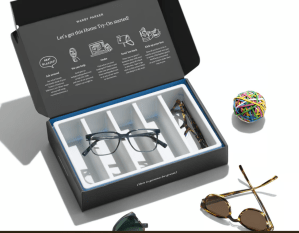
Warby Parker’s “Home Try-On Campaign” and free shipping, among other elements of their social media marketing strategy, helped them reduce cognitive dissonance for consumers that were considering switching eyeglass brands. The company made their endeavor as easy as possible for consumers to try, with as little risk as possible. Warby Parker was basically saying, “Would you like to try this? If you like it, then we can talk further. If you don’t, then no harm done, and no strings attached. Freedom of choice is yours. We’re simply offering something we think will help solve your problems in a better way than the other guys” (these are my words of course to make a point).
Do Good For Others
Warby Parker also used a socially conscious business strategy to help provide an alternative narrative to show that they were not just innovative and user friendly to their customers, but they were on a mission to change the world for the better. They aimed to show that they weren’t just a company looking to sell a product; they were a company looking to help change the world. They did this by adding to their credibility by showing they could be involved in social causes outside of their regular business model. Mahoney and Tang (2016) state, “By teaming up with the company VisionSpring, the company is able to provide a pair of eyeglasses for a person in need for every pair of Warby Parker glasses that a consumer purchases. This socially conscious business strategy makes people feel good about changing their purchasing habits. It has proven a mutually beneficial strategy for the Warby Parker business, its audiences in need of eyeglasses, and the globalized world alike” (p. 19).
Use Social Media To Listen, Engage, and Promote Behavior Change
Effective marketing is about relationships, communication, and customer behavior.
The key to effective marketing goes beyond great selling points and great communication. Effective marketing is about relationships, communication, and customer behavior. Social media allows us to bridge that personal divide that was far more difficult to overcome during the era of mass marketing which treated everyone as the same with one disseminated message rather than personal messages tailored to each individual’s needs.
How do we attract new customers, and persuade them to opt out of the other guy’s products and services and go for ours? We change their behavior. However, change does not come without resistance. By using effective social media marketing strategies, we can make this change easier and less painful. We can utilize these strategies along with social media technology to engage more with our consumers on a more personal level through listening, communication, and engagement. When the customer feels a stake in the game, when they feel more connected to the brand and product, and when they feel a sense of trust and belonging, they are more willing to choose our brand over the competition.

Make it personal. Promote engagement. Initiate change. That’s the power of social media.
Works Cited
Mahoney, L.M., & Tang, T. (2016). Strategic Social Media: From Marketing to Social Change. John Wiley and Sons.
Warby Parker. (2024). History. Warby Parker. https://www.warbyparker.com/history
Share this:
#warbyparker #snhusmm #paulwromero
 Paul W Romero
Hey Paul,
Social Media has definitley changed the game when it comes to how business sales are now being conducted, how sales is impacts a business’s bottom line, and how businesses are able to communicate with their target audience and customer base.
For example, since the induction of social media many businesses are now being operated without physical cash being exchanged and from non traditional locations that require little to no human contact. However, social media has had a positive impact on sales for businesses as a result of businesses engaging their targeted audiences and the consumers able to receive timely feedback from the businesses, McCue, T. (2019, April 18). As businesses create creative content through social media, consumers they are attracting customers to buy into their services or products.
Social media has also reduced the cost of marketing for businesses in comparison to traditional print based marketing that many were once accustomed to in the past such as TV, Radio, and print. Social media has now given businesses an advantage over traditional marketing channels because it allows the business to reach a larger audience at a fraction of the cost because of the exposure that the internet gives to users, SBDC, O. (2024, May 31)
SBDC, O. (2024, May 31). Benefits of social media marketing for small businesses. Oregon Small Business Development Center Network. https://oregonsbdc.org/how-small-businesses-can-leverage-social-media/
McCue, T. (2019, April 18). Social media is increasing brand engagement and sales. Forbes. https://www.forbes.com/sites/tjmccue/2018/06/26/social-media-is-increasing-brand-engagement-and-sales/
LikeLike
Hi Paul,
Warby Parker’s innovative use of social media has been instrumental in their success as a disruptive force in the eyewear industry. By focusing on key social media strategies such as listening to customers, creating conversation (versus lecture like you astutely pointed out) and engaging them with social causes has created a community of loyal customers. By encouraging the customers to post photos of their glasses, write opinions and give reviews…the company is opening up the space for the customers to supply content (or User Generated Content). Although this method of allowing user generated content reduces the level of control the company has on its brand message, it increases the level of participatory communication (Mahoney & Tang 2016).
You did a great job showing the importance of communicating with the customer and not controlling the conversation. Warby Parker’s team consistently responds to comments on social media platforms and validates customers needs and requests. It truly is a two way communication that fosters relationship. By treating customers as informed individuals rather than passive recipients of information, Warby Parker demonstrates immense respect for their audience. This approach creates a strong sense of ownership and control (locus of control), empowering customers and, in turn, transforming them into passionate brand advocates (Mahoney & Tang 2016).
I appreciate that you tackled how Warby Parker attacked cognitive dissonance with customers unsure about switching eyewear brands. By allowing potential customers to test five frames at home with zero cost and free shipping, they really take away any excuse a customer has to not try.
You cleverly outlined the additional path to win a customer over with Warby Parker’s commitment to social good with their “Buy a Pair, Give a Pair” program that has donated millions of glasses to people in need. The company showcases how many pairs of eye glasses they give away on all their platforms which positions them as a brand with a purpose to help society (Mahoney & Tang, 2016).
Mahoney, L.M., & Tang, T. (2016). Strategic Social Media: From Marketing to Social Change. John Wiley and Sons.
LikeLike
Hi Paul! I just want to start off by commenting on how organized your blog layout looks. I appreciate all the subheadings and thought you chose very eye-catching pictures.
I think that your blog post is very detailed and very well written. I also really appreciate how you tied in the course concepts into the company’s social media strategy. Topics such as cognitive dissonance, transactional communication and socially conscious consumers were all discussed in a way that was easy to understand and read like a conversation.
Additionally, I really like how you mentioned in your post how Warby Parker has been so successful because of utilizing social media in their marketing strategy. The company uses social media to connect and communicate directly with consumers. I agree with your statement that if the company used a more traditional approach, without using social media, they would not have been as successful as they are now. There would have been less communication, less opportunity to build a more personal connection and therefore less of a chance that consumers would have given this new company with this new idea a chance. I think that it’s really fascinating how social media can open new doors to not only new marketing strategies, but new business ideas as well.
Lastly, I also liked that you touched on the company’s socially conscious business strategy. I agree with your statement “They aimed to show that they weren’t just a company looking to sell a product; they were a company looking to help change the world”. That part of their mission is to change the world for the better. I agree that this made consumers more willing to purchase glasses from Warby Parker, especially if doing so meant that the company would donate a pair of glasses to people in need. I think often, people feel that to make positive change in the world, they need to do something big. But Warby Parker showed people that by simply purchasing a pair of glasses, they could be part of something bigger. It can feel like a small act, but these purchasing decisions are part of a much larger movement towards positive change.
Best,
Monya P
LikeLike