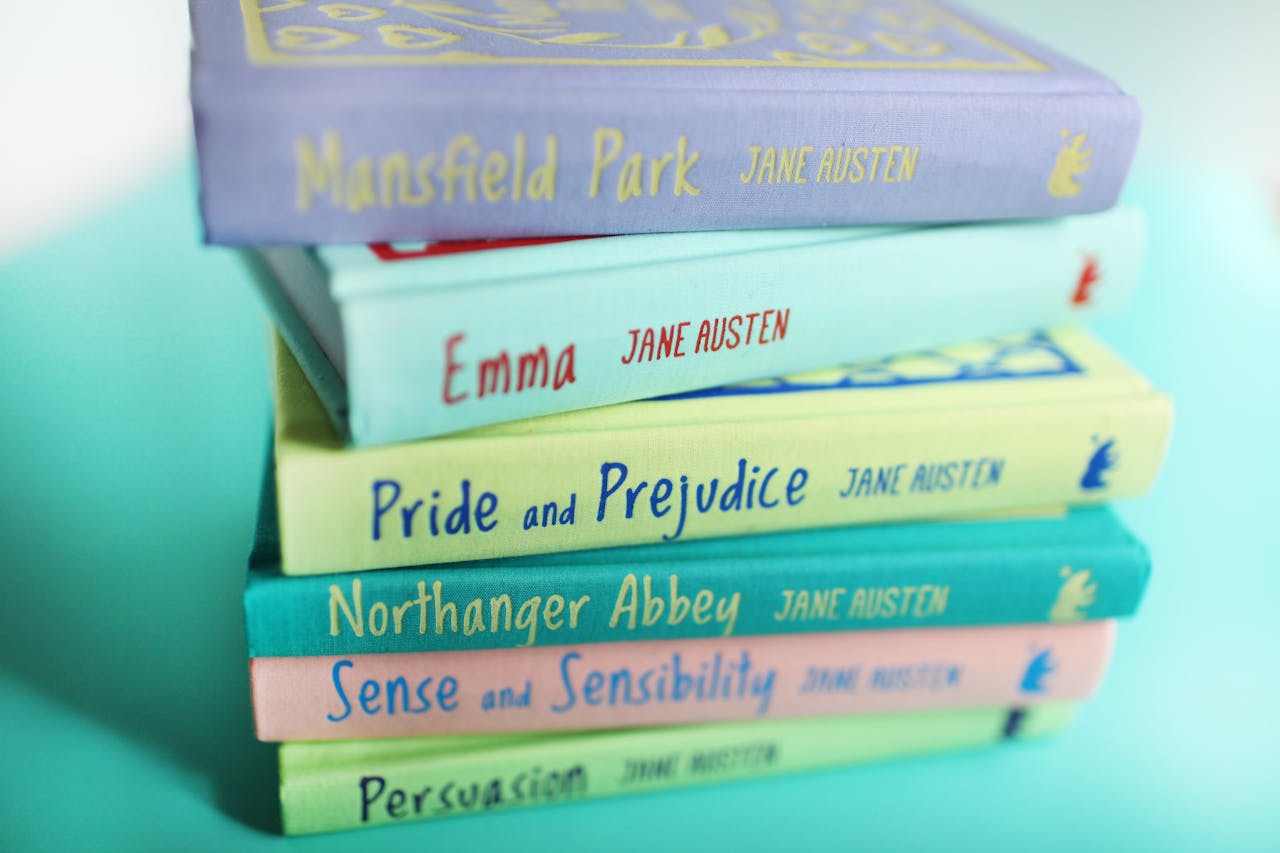
Image Source: Photo by Leah Newhouse on Pexels
First published: June 18, 2025 Paul W. Romero
Preface: This was originally written on December 2, 2022 for an assignment for my MFA program.
It is a truth universally acknowledged that most men do not read or write romance novels. According to the Romance Writers of America, only 18% of romance readers are men while 82% are female (Romance Writers of America). Some notable romance authors include Jane Austen (Pride and Prejudice), Nora Roberts (Year One), Danielle Steel (A Perfect Stranger), and Nicholas Sparks (The Notebook).
It is a truth universally acknowledged that most men do not read or write romance novels.
Romance novels I have read so far include Fifty Shades of Grey, The Fault in Our Stars (to me it’s a teen romance novel, but others will argue that it is more YA than romance), Ana Karenina (which I hope to finish before I expire), and Pride and Prejudice (which I surprisingly and ardently adore). Other authors I’m familiar with but whose books I have not read include Claire Lydon, Kresley Cole, Karen Marie Moning, and Kait Ballenger.
The Romance Writers of America website states, “The future of romance is the younger emerging readership” (Romance Writers of America). Furthermore, according to the Romance Writers of America, more younger readers are becoming diverse in sexual orientation and ethnicity (Romance Writers of America).
“The future of romance is the younger emerging readership” – Romance Writers of America
Regarding the characteristics of the romance genre, according to the Romance Writers of America, “Two basic elements comprise every romance novel: a central love story and an emotional satisfying and optimistic ending” (Romance Writers of America). The website also states, “Romance novels may have any tone or style, be set in any place or time, and have varying levels of sensuality – ranging from sweet to extremely hot. These settings and distinctions of plot create specific subgenres withing romance fiction” (Romance Writers of America).
These subgenres include contemporary, erotic, historical, paranormal, romance with spiritual elements, romantic suspense, and young adult romance (Romance Writers of America). I believe the romantic suspense subgenre could suit my ex-girlfriend serial killer story (still a work in progress) as the subgenre includes, “romance novels in which suspense, mystery, or thriller elements constitute an integral part of the plot” (Romance Writers of America).
From what I researched, two of the main issues concerning the romance genre is a lack of diversity and misrepresentation of female characters. On the first point, Copeland quotes the owners of The Ripped Bodice bookstore as stating, “While many groups are still woefully underrepresented in the romance genre including people with disabilities, marginalized religious groups, and members of the LGBTQ+ community, we had to start somewhere” (Copeland, “Romance Novelists Are Advocating For Social Change Inside And Outside The Genre”). On the second point, according to an interview by Jordon, author Jeannie Moon states, “Some of the guys…just don’t get it. Especially with anatomy. James Patterson does a great job with women, not Nicholas Sparks” (Jordon, “The Romance Genre May Have a Female Problem”).
The romance genre relates to storytelling in that it’s primal. Snyder states, “…Primal urges get our attention. Survival, hunger, sex, protection of loved ones, fear of death grab us. The best ideas and the best characters in the lead roles must have basic needs, wants, and desires” (Snyder 54).
Hedlund states, “I want to pose several reasons why I think romances are a valid and important form of literature: Romances give us better insight into relationships…Romances can inspire hope in life…Romances are a fun form of entertainment…Romances renew our belief in love” (Hedlund, “4 Reasons Romance Novels Are an Important & Valid Type of Literature”).
I believe romance is vital because it is a primal emotion that we can all relate to. Romance is a universal thing that most humans, being the social creatures we are, strive to achieve. As with any other fiction book we read, we want an escape from reality to something fantasy. We read superhero stories because we dream that we can be superheroes ourselves. We read about less fortunate characters so that we don’t feel so alone in our misfortunes. We read romance so that we know we are not the only hopeless romantics, or that we can be part of a majestic love story, or that we can look into another person’s world and their experiences (being fiction or nonfiction). Romance is vital to storytelling because it’s primal and relatable and that is what makes it so marketable.
Romance is vital to storytelling because it’s primal and relatable and that is what makes it so marketable.
Works Cited:
Copeland, Carolyn. “Romance Novelists Are Advocating For Social Change Inside And Outside The Genre.” Prism, https://prismreports.org/2020/12/30/romance-novelists-are-advocating-for-social-change-inside-and-outside-the-genre. Accessed 02 Dec. 2022.
Hedlund, Jody. “4 Reasons Romance Novels Are an Important & Valid Type of Literature.” Inspired By Life…And Fiction, https://inspiredbylifeandfiction.com. Accessed 02 Dec. 2022.
Jordon. “The Romance Genre May Have a Female Problem.” Whalebone, https://whalebonemag.com/romance-genre-female-problem-books. Accessed 02 Dec. 2022.
Romance Writers of America, https://www.rwa.org. Accessed 28 Nov. 2022.
Snyder, Blake. Save the Cat: The Last Book on Screenwriting You’ll Ever Need. Studio City, Michael Wiese Productions, 2005.
Share this:
 Paul W Romero