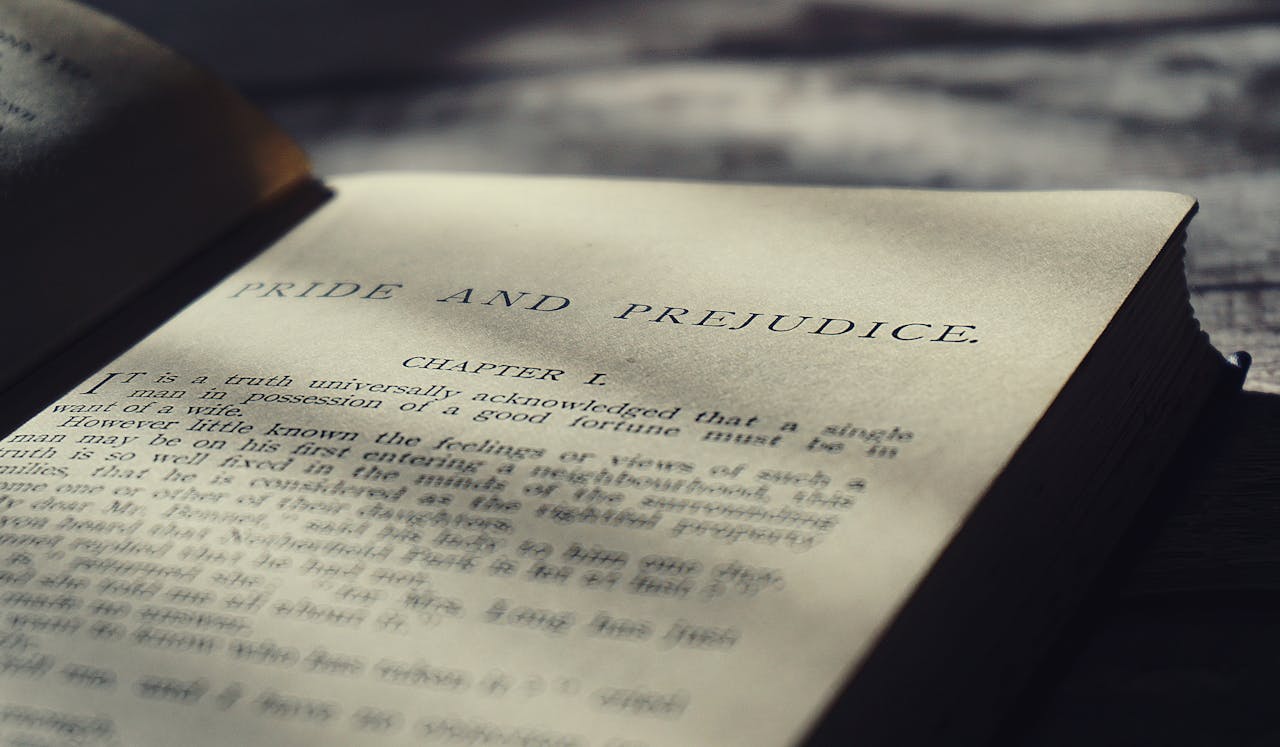
Image Source: Photo by Suzy Hazelwood on Pexels
First published: June 18, 2025 Paul W. Romero
Preface: This was originally written on September 18, 2022 for an assignment for my MFA program.
As times change so do the hunks and the romance tropes. Well, maybe not all of them change. After all, love is timeless, but many of them evolve.
One romance trope that both Jane Austen and Sonali Dev use in their novels is the hunk trope. Each generation defines their own take on beauty which resonates in the shift from Austen’s literary work to Dev’s contemporary one. In Austen’s work, men are depicted by their tall statue and manly qualities, where Dev’s hunky man is depicted more by his muscles rather than his height. Despite both Austen’s and Dev’s similar use of the hunk trope, there is a contrast in how each author perceives the hunk trope and this may correlate with the times in which they lived.
Each generation defines their own take on beauty.
Gould states, “In days gone by, it’s easy to see the appeal to the female reader of a story about winning over the seemingly unobtainable man, this during an era when ‘winning over’ was a real-world necessity” (Gould, “Writing Male Characters for Romance Novels”). This is in reference to the era pre modernism where women could not work, could not vote, and did not have a say in society.
Times have changed, and women have become more independent along with having a voice in society in which they can express their desires, interests, and concerns. This led to a change in what they considered adequate for a mate as seen in the shift from Austen’s novel to Dev’s. Austen’s was about the man having social status and wealth. Dev’s wrote the opposite and wrote the woman with social status and wealth.
Times have changed, and women have become more independent.
In Pride and Prejudice, Austen writes, “But his friend Mr. Darcy soon drew the attention of the room by his fine, tall person, handsome features, noble mien, and the report which was in general circulation within five minutes after his entrance, of his having ten thousand a year” (Austen, 2011, ch. 3, para. 5). This is Austen’s description from the Regency England era, which contrasts to Dev’s contemporary description. In Pride, Prejudice, and Other Flavors, Dev writes, “The chef on Chopped looked nothing like DJ-no smoothly shaved head, no undulating biceps, no deep dimple in his stubborn chin, no innate gentleness when he interacted with people” (Dev, 198).
Austen keeps her description simple and omniscient, leaving the rest to the imagination of the reader, but does describe Mr. Darcy as being tall, handsome, and wealthy. Dev uses the frequent mentioning of DJ’s biceps, which is something I would expect to see in a contemporary romance novel. Since the era of Regency England, women have more power of choice to decide on what mate they wish to have, if any, and this leads to more desired qualities rather than just tall, handsome, and rich.
Fiore states, in reference to a 2007 survey conducted by Richard A. Lippa among roughly 120,000 men and nearly 100,000 women, “It’s worth noting that ‘good looks,’ ‘facial attractiveness,’ and ‘fitness’ were all rather high up on the women’s list as well” (Fiore, “What Women Want in a Man”). Dyhouse states, “As the twentieth century progressed, younger women became more independent. As wage earners and consumers, they began to express preference” (Dyhouse, 2017, introduction, para. 5). Lastly, Gould states, “Although there may still be inequalities, there are I’m pleased to write, plenty of alpha females out there, women who are more powerful, sexually and socially confident, and financially successful than their male counterparts. Women take the lead in starting, maintaining, and ending relationships every bit as much as men do” (Gould, “Writing Male Characters for Romance Novels”).
Novels are snapshots of history. They show how history evolves and in doing so, the writing of the various genres of literature evolves as well. As seen with Austen’s and Dev’s novels, the bridge from literary to contemporary still holds the same values of a lady wanting to find the love of her life to live happily ever after. However, what is considered the love of her life has shifted as seen from Austen’s depiction of a tall, handsome, hunky, wealthy man to Dev’s depiction of a muscular man.
Novels are snapshots of history.
In Austen’s novel, the main character, Elizabeth, refuses her family’s urgency to marry for wealth. In Dev’s novel, the main character, Trisha, refuses her family’s urgency to marry for social status. In Austen’s time, the men had the wealth which proved to be an attractive feature, whereas in Dev’s novel, the female character has the wealth and has the freedom to fall in love with whoever she wants regardless of wealth or social status. The use of the hunk trope in both Austen’s and Dev’s romance novels is very apparent and appropriate to the expectations of the genre, but both authors use the hunk trope in different forms which has a correlation to the era in which they wrote their novels.
Works Cited:
Austen, Jane. Pride and Prejudice. E-book ed., Finisterra Books, 2011.
Dev, Sonali. Pride, Prejudice, and Other Flavors. New York, HarperCollins Publishers Inc., 2019.
Dyhouse, Carol. Heartthrobs: A History of Women and Desire. E-book ed., Oxford University Press, New York, 2017.
Fiore, Giulia. “What Women Want in a Man (According to Science).” Confidence to Achieve, https://confidencetoachieve.com.au/what-women-want-in-a-man-according-to-science. Accessed 15 Sept. 2022.
Share this:
 Paul W Romero