
Image created in Midjourney by the author
First Published: September 23, 2024 Paul W. Romero
What do you find more compelling? A platform that tells everyone the same thing and only allows you to listen? Or a platform that allows you to create your own content, connect with people you want to connect with, and tell the message you want to tell?
As time has evolved, more and more social media users are shifting from the role of viewers to content creators. Everyone has a story to tell. Everyone wants to be a part of a community. Everyone wants to play a part in the bigger picture. Well for the most part at least (can’t forget my fellow introverts).
Orkut Case Study
Mahoney and Tang (2016) state, “Orkut is structured similarly to other social networking sites. The original purpose was for users to find communities through keyword search, including titles, description, and browsing through other users’ memberships (Spertus et al., 2005)” (p. 192).
Orkut successfully used the marketing action plan laid out in L. Meghan Mahoney and Tang Tang’s textbook, Strategic Social Media: From Marketing to Social Change, by successfully outlining its goals, target audience, social media choices, resources, policies, monitoring, and activity plan (Mahoney and Tang, 2016).
Mahoney and Tang’s Design Framework Action Plan (Mahoney and Tang, 2016)
Mahoney and Tang (2016) outline a seven-step design framework action plan which includes the following steps (p. 183).
- Goals
- Target audience
- Social media choice
- Resources
- Policies
- Monitoring
- Activity Plan
Orkut’s success was due to its ability to understand the connection between technology and culture. In doing so, the company was able to create a platform that would adhere to its target audience’s needs which would create value and increase brand awareness and authority.
Orkut’s goal was to engage with as many users as possible through an easy-to-use platform. Orkut knew its target audience and what they valued in their social media choices and utilized whatever resources the company had to implement this easy-to-use platform.
Bottom line: the company knew the needs of its customers and did its best to adhere to those needs.
The company knew the needs of its customers and did its best to adhere to those needs.

Mahoney and Tang (2016) state, “Early users were eager to try Orkut because of Google’s strong reputation…. Orkut’s interface was clean, simple and sophisticated, making it easy for users to navigate and join communities” (p. 192).
Where Orkut fell short was in monitoring, implementing and sustaining polices and an activity plan. It seemed the company stayed in one state of mind and never adapted or updated itself to meet the changing and growing needs of its customers.
Culture and Technology
Mahoney and Tang (2016) state, “Though social media offers new opportunities for businesses to market themselves to a larger global audience, the most successful companies are those able to utilize social media platforms to better communicate with individual users” (p. 180). Furthermore, Mahoney and Tang (2016) state, “Brazilians are especially responsive to brand strategies that include online video, something that was difficult through Orkut. As such, the demise of Orkut seemed to deal with functionality problems with the website, including blockages, limiting the number of friends, and difficulties in loading and sharing photos (Translate Media, 2015)” (p. 192).
Orkut’s community structure spoke to the changing role of the digital consumer by allowing users to engage and connect with other users. It created a sense of prestige and membership along with social reputation and status. Orkut’s design appealed to many facets of social media behavior.
Mahoney and Tang (2016) state, “It allowed users to connect with not only people they knew interpersonally but people they admired” (p. 192). Mahoney and Tang (2016) continue to state, “Orkut also carried a high prestige factor due to its invite-only membership list. Being a member of the social networking site meant that you were well connected in the technology realm” (p. 192).
Consumers would be more interested in participating with these messages rather than a diffusion strategy because as stated previously, what would you rather have? A person who talks to you in a lecture, or a person who engages with you in a conversation? Orkut dumped the “one message for all” approach for a customized “tailored to your interests” approach which appeals more to people who have different interests but still use the same platform.
Brazilian culture spoke to the brand experience of organizations and communities in Orkut by giving Orkut an insight as to what its target audience would potentially be comprised of which aided the company in implementing goals, polices, and an activity plan. Orkut allowed its users to connect with its community via engagement activities as mentioned previously. Where they fell short was the continued monitoring of that target audience and their changing needs as well as the growing connection and evolution between technology and culture. Users wanted social gaming, and online video which Orkut could not provide, and thus the bond was broken between the organization and its community. As a result, Orkut shut down in 2014.
Mahoney and Tang (2016) state, “In order for brands to be successful in Brazil, they must allow users to blog, engage through social gaming, and incorporate online video into marketing campaigns (Translate Media, 2015). Brazilians are especially responsive to brand strategies that include online video, something that was difficult through Orkut” (p. 192).
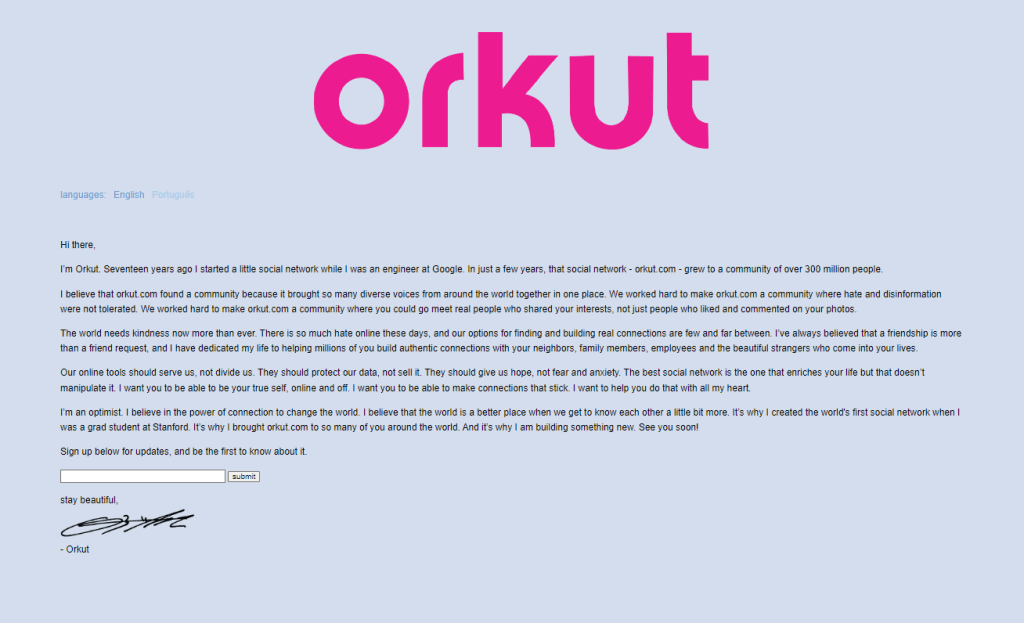
Meet Your Customer’s Needs
When you stop meeting the needs of your consumer, they will find someone else to meet those needs.
In a culture where brands must engage their fans on various digital platforms, I would advise to have a message tailored to customization not only among various individuals but also across various platforms.
What marketing strategy may work on one platform may not necessarily work on another. Thus, it is imperative to do as much continued research and monitoring as possible in order to stay abreast of the latest trends in technology and social media marketing.
Don’t Stop Learning. Don’t Stop Growing.
What marketing strategy may work on one platform may not necessarily work on another.
In a highly competitive world that is only getting more competitive, it is imperative to stay as much ahead of the curve as possible. Don’t follow trends. Create new ones. Don’t create one single diffusible message. Create a customizable message. Listen and grow. Adapt and be willing to change. Engage don’t lecture. Go with the flow and continue to learn the connection between technology and culture.
Works Cited
Spertus, E., Sahami, M., & Büyükkökten, O. (2005). Evaluating similarity measures: A large-scale study in the Orkut social network. In: Proceedings of the 11th ACM SIGKDD International Conference on Knowledge Discovery in Data Mining, pp. 678-684. New York: ACM Press.
Translate Media (2015). Brazil social media. Available at https://toppandigital.com/us/translation-service/social-media/brazil-social-media/ (accessed June 8, 2016).
Share this:
#snhusmm #paulwromero
 Paul W Romero
Hi Paul,
I once again enjoyed reading your blog. You have a great blog writing voice, laid back yet confident. I always feel like I’m reading from a social media expert. Your posts are both informative and easy to consume. I especially like your use of fonts, section breqaks and images against the sleek format and theme.
You’re statement, “The company knew the needs of its customers and did its best to adhere to those needs,” is on point. One of the issues I had with this case study is that L Mahoney and Tang Tang chose to hang Orkut out to dry with their inability to consider both technology and culture, but as with most things, it was more complicated than that. First, Orkut didn’t have much a global presence yet in 2004. It would have hard to predict at that time where they would take off. That being said, however, they also starting Western audiences too when they were no longer able to meet their needs. Second, Orkut was basically a prototype that was never intended to have more than 300k- 400k users (hence the invite-only membership). Finally, even by 2014 anyone wanting to conduct social media marketing should have known to use multiple platforms, using each based on their unique functions. As we have learned, Word of Mouth (WoM) is incredibly powerful, and it’s not about the number of followers but the level of engagement that makes it so. As part of a marketing plan, it still had something to offer the users of Brazil in conjunction with other platforms.
Great post!
Lisa
P.S. On behalf of all our fellow introverts, thanks for the shout-out!
LikeLike